
Why Students Need Systems Thinking to Solve Complex Problems
In today’s rapidly changing world, students are expected to do far more than memorise facts. Whether they are studying science, economics, or environmental issues, many of the challenges they encounter involve complex systems where multiple factors interact.
For students in rigorous programmes such as IGCSE and the International Baccalaureate (IB), success increasingly depends on their ability to understand how ideas connect and influence one another. This ability is often described as systems thinking.
Systems thinking helps students move beyond isolated facts and develop a deeper understanding of how different parts of a problem work together. In a world shaped by technological change, global interdependence, and complex scientific challenges, this skill is becoming increasingly valuable.
What Is Systems Thinking?
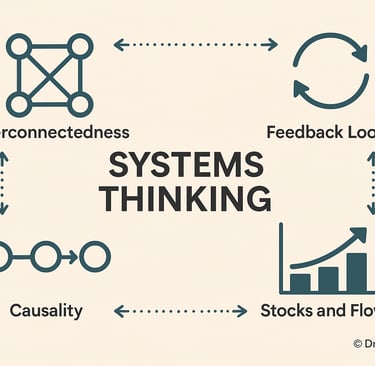
Systems thinking is the ability to understand how different elements interact within a larger whole. Instead of examining individual pieces of information separately, students learn to recognise patterns, relationships, and cause-and-effect interactions.
For example, when studying an ecosystem in biology, students must consider how plants, animals, climate, and human activity influence one another. Changing one element of the system can produce effects throughout the entire ecosystem.
Similarly, in physics, students must often analyse how different variables—such as force, mass, and acceleration—interact within a system.
Systems thinking encourages students to ask questions such as:
How do these factors influence one another?
What happens when one variable changes?
What patterns or relationships can be observed?
By exploring these relationships, students develop a deeper and more flexible understanding of complex topics.
Why Complex Problems Require Systems Thinking
Many real-world problems cannot be solved by looking at a single factor in isolation. Instead, they involve interconnected systems where multiple variables influence outcomes.
Consider challenges such as:
climate change
public health
economic development
technological innovation
Each of these issues involves many interacting components. Understanding the full picture requires the ability to analyse relationships and recognise how different parts of a system influence one another.
Students who develop systems thinking skills are better equipped to analyse complex situations and identify meaningful solutions.
Systems Thinking in Science Education
Science subjects provide many opportunities for students to develop systems thinking.
In biology, students explore complex biological systems such as cells, organs, and ecosystems. Understanding these systems requires recognising how different processes interact.
In chemistry, students learn how changes in temperature, concentration, or pressure can affect chemical reactions. These changes influence the entire system.
In physics, students often analyse how forces interact within a system, such as the movement of objects or the transfer of energy.
Students who approach these subjects through systems thinking often develop a deeper understanding because they can see how individual concepts fit together within a larger framework.
Systems Thinking Encourages Deeper Learning
Students who rely mainly on memorisation may perform well on simple recall questions, but they often struggle when questions require them to apply knowledge in unfamiliar situations.
Systems thinking helps students move beyond memorisation and develop conceptual understanding.
When students understand how ideas connect, they can:
apply knowledge to new problems
explain scientific processes more clearly
analyse data and experimental results more effectively
adapt their thinking when faced with unfamiliar questions
This deeper level of understanding is particularly important in programmes such as the International Baccalaureate, where students are expected to analyse complex concepts rather than simply recall information.
Preparing Students for the Future
Beyond school examinations, systems thinking is increasingly recognised as an important skill for future careers.
Modern industries—from engineering and medicine to environmental science and technology—often involve complex systems that require careful analysis.
Professionals working in these fields must understand how multiple variables interact and how changes in one area can affect the entire system.
By developing systems thinking skills early, students learn to approach problems in a thoughtful and analytical way. These skills not only support academic success but also prepare students for the kinds of challenges they may encounter in university and beyond.
Encouraging Systems Thinking at Home
Parents can help support the development of systems thinking through everyday conversations and learning activities.
For example, parents might encourage students to ask questions such as:
What factors might influence this outcome?
How are these ideas connected?
What might happen if one part of the system changes?
Discussing real-world issues—such as environmental changes or technological developments—can also help students practise thinking about complex systems.
The goal is not simply to find quick answers but to encourage curiosity about how different elements interact.
Supporting Stronger Thinking Skills
Developing systems thinking takes time and practice. Students benefit from opportunities to explore ideas deeply, analyse relationships, and apply their understanding to new situations.
When students strengthen these thinking skills, subjects such as science often become more engaging and meaningful. Instead of memorising isolated facts, they begin to see the underlying patterns and connections that make complex topics easier to understand.
For parents, supporting the development of strong thinking skills can be one of the most valuable investments in a child’s education.
Get in Touch
Questions? We are here to answer your questions over chat if preferred.
© 2026. FluentMentors.com All rights reserved.